Note : The following work above (video) is created for those who are interested in crime drama television series such as CSI and is a parody of the series' opening credits with the purpose of showcasing MTI's artistic talent. Make sure your speakers are connected and the volume is turned on once the video starts to play. Thank you !
After some time of investigation, we have successfully collected several evidence which we can finally use to connect the dots!
"Question 5
Match the photos of the victims’ pieces of evidence, explaining your rationale for doing so. "
Based on our previous episode on deciphering the jaws & skull found, we finally got our hands on the list of potential victims shortlisted by our Forensic Analyst. Aren't you eager to know which belongs to who? Look at that anticipation on your face!
Without further ado, quench your thirst of excitement with the below MTI Goodness!
Just a few more steps in unraveling this mysterious murder case ! Can you solve it in time?
Allow us to present Part 3 of the story to you today ! :)
PART III - MURDER MOST BRUTAL
A day later at the mortuary....
“You called me in, doc? Asked Detective Dr. Suria as she come up to Dr. Rudi who was waiting for her. “Anything new developed?” “Well,” Dr. Rudi sighed, “Other than what I had told you earlier, nothing much really. I have taken some shots of the items. Here, have a look. There are other pieces of a jaw and I found some missing teeth too” “Missing teeth, did you say?” Dr Suria asked, excited about what she has heard. Anything additional will help her piece the puzzle together!
Dr. Rudi shrugged, “Sorry Dr. Suria, with only this much of evidence, I can’t seem to be able to do much. But….you have the files of some of the possible victims, right?” “Ya lah….” Dr. Rudi replied. “Herman Hartono and his son, Adi Hartono who lived a few blocks away from here. Also, Anya Suriati and Tanya Rosilawati, a pair of 9-year old twin girls, whose father filed a missing person’s report of Anya four months ago” “OK, I think we can match the dental records of those people with these evidences,” said Dr. Suria. “Send me their records and any radiographs taken too.” Dr. Suria continued, “I have also processed for possible DNA profile and still waiting for a match in the system. Fingers crossed…we might be lucky!”
And here are the mind-boggling questions ! Give them a try !
Question 5
Match the photos of the victims’ pieces of evidence, explaining your rationale for doing so.
Question 6
The DNA profile showed evidence for a father and son. In addition there was DNA profiling pattern that matched one living twin (Tanya Rosilawati). With this, match the evidence to these victims who were earlier filed for missing persons. Explain your rationale.
Don't go anywhere because the answers will be up next !
Welcome back folks, now that we have studied and examined the evidence found, I guess it's about time we move on to further investigation! Like the forensic movies, where do you think we should go now?
"QUESTION 5: Part 2: Considering the evidences available up to
this point in time, describe in detail how you would go about investigating
further, assuming you are Dr. Rudi or Dr. Suria, explaining what you anticipate
at each step"
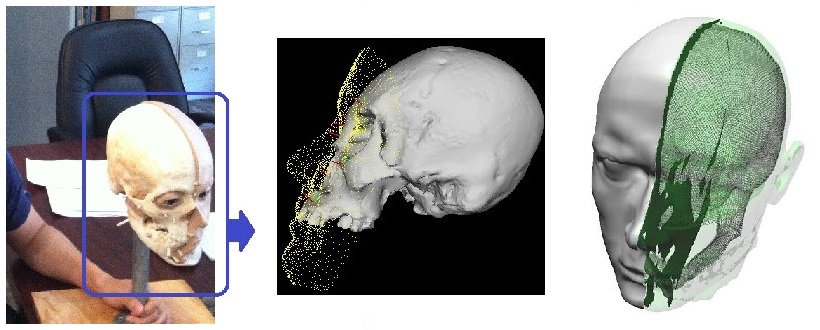
FACIAL RECONSTRUCTION is a process where the face of an individual is built onto the skull for the purpose of identification. As seen here, our detectives (Detective G and Detective M) are using a FACIAL RECONSTRUCTION program to try and get a better picture of the victim's appearance using the skull from the evidences found. Through this program, we are trying to match the face of the victim with faces from the database and perhaps narrow down the list of missing people. Each face is unique to the individual, and hence, this will give us a major clue to identifying the victim. We can also try matching medical and dental reports using this method.
Detectives G and M hard at work, trying to fit in the victim's face to
the skull using the 3D computerised facial mapping.
There are
many ways to reconstruct a face from a skull, and the many factors are a huge
challenge for the investigators. Besides taking into account the hard and soft
tissues of face, facial tissue depth measurement, one also needs to consider the
factor of age, where juvenile reconstruction requires different attention.
Detectives J, G and M brainstorming for more clues, hopefully it can lead us to identifying the victim...
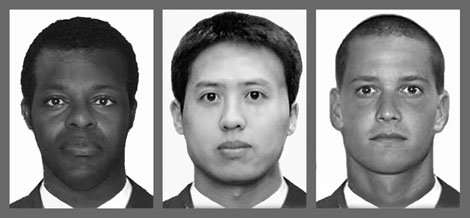
Example of a missing person brochure to capture attention of people to help look out. This way, we can try to match the victim's reconstructed face with the picture given in the database or through the list/report on missing people. This is where our short listing and crossing out of names start! Based on the findings from the skull and reconstruction, the missing people selected are roughly of the same age group, has facial similarities, and perhaps vanished around the same time frame. From here, further investigations have to be carried out to confirm the identity of the victim.
After
further shortlisting of the missing people’s list, it’s time to look up for the
family and friends of the suspected victim for further investigations.
Detectives G and F approaches the suspected victim's biological parents to enquire more and to obtain some new DNA material such as, hair or bodily fluids.
Details of the victim have to be reconfirmed and a relayed, detailed, and descriptive information is necessary.
After collecting blood samples, Detective J is on his way to start DNA PROFILING! DNA profiling requires a special method of analysis known as polymerase chain reaction or PCR. DNA profiling is no longer an unheard term now. In fact, this is the tool of forensic scientists as it provides accurate results and is used for the vast bulk of tests, including paternity testing. DNA determines the uniqueness of every person and thus, has DNA profiling has helped solve countless crime cases.
Detective J is working on the amplification of DNA with PCR.
Several components, like a data interface, detector, carrier gas line, gas flow controller and column, constitutes such a machine. For instance, Gas chromatography instrument is utilized in spitting and examining compounds, while a thermal recycler amplifies the segment size of the DNA.
Detective J and F are comparing the DNA profile of the skull
and the DNA fingerprinting of the suspicion's family, hopefully they are on the
right track to discover the skull's identity!
From
the teeth the detectives discovered in the evidences, there seem to be a
few caries and fillings done to it.. Hmm.. Perhaps it's time to pay a
visit to the suspected victims' dentist and looking up on the DENTAL RECORDS.. That might lead to something...
Detective J and M
are gathering dental records from the dentist to aid in personal
identification. A dental record is the detailed document of the history
of the illness, physical examination, diagnosis, treatment, and the
management of a patient, hence the detectives will have a closer step to
find out the skull's owner by matching the dental records with the
skull findings.
Now that we have done discussing Question 4, what say you if we look into the evidence our forensic team have found? Ah, it has come to the time for us to put everything we've learned in the previous chapter into practice!
I can see that squirt of excitement in your eyes there! :D
"QUESTION 5:
Part 1: List the evidences that have been presented
to both the doctors"
So ladies & gentlemen, what do you think? How many victims are there exactly? A male? Female? Adult? Child?
Well well, here we have a video specially made to you from us! *screams yayy*
CLICK or CLICK, you don't have a choice! Heh, Enjoy!
Today, we shall look into DNA profiling ! DNA is in your blood and in your bones too! It's fascinating to know that DNA makes you who you are today and helps a great deal in forensic science.
In the past, the analysis of DNA has
been successfully employed in criminal cases, disaster victim identification
and paternity testing. DNA profiling reveals a suite of variations in the
genetic code that, taken together, constitute an individual’s unique DNA
profile. In cases of mass disaster, the remains are usually skeletonised where
the bodies have been badly degraded and the bodily tissues have decayed. DNA profile
has to be performed from mitochondrial DNA (mtDNA) extraction because nuclear
DNA can hardly be extracted from these remains.
The sequence of mtDNA is entirely functional and
highly conserved, so there is very little variation between individuals. The
focus in forensic analysis of mtDNA is on the hypervariable regions – HV1 and
HV2 – within the control region (a 1000 base pair long non-coding D-loop). The
variations within these regions are generally single nucleotide
polymorphisms. mtDNA is also subjected to high rate of mutation due to its
lack of DNA reparation, causing variation between individuals.
Step 1 – DNA extraction
1.Lyse
sample cells in a buffer solution.
2.Centrifuge
the denatured proteins and fats.
3.Pass
the cleared lysate through a column containing a positively charged medium that binds to the DNA.
4.Remove
contaminating proteins, fats and salts through several washes.
The minute mtDNA obtained has to be
amplified by Polymerase Chain Reaction (PCR). PCR enables a single copy of a
DNA fragment to be amplified to millions of copies in just a few hours.
Component required
Function
Oligonucleotide
primer x2
Mark complementary
DNA target to be amplified.
―
Base sequence of one primer binds to one side of the target, the other
primer binds to the other side of the target, with the DNA between the
primers.
Fluorescent tags
Visualize amplified
DNA in electrophoresis.
Polymerase enzyme
Allows DNA strand to
be copied by adding nucleotides to 3’ end of primers.
Reaction buffer with
MgCl
Ensures ideal
conditions for functioning of polymerase enzyme.
Deoxyribonucleotides
Builds DNA molecule.
Template DNA
Constructs messenger
RNA.
The PCR process is conducted in a
small, plastic centrifuge tube, and the cycle consists of:
1.
Denaturation:
heat the sample to 94-95°C for 30 seconds.
―
Allows
primers to access by breaking hydrogen bonds which separates the
double-stranded DNA.
2.
Annealing:
keep the sample at 50-65°C.
―
Allows
hydrogen bonds to form between the primers and the complementary DNA sequence.
3.
Extension:
heat the sample to 72°C for a duration depending on the length of the DNA
strand to be amplified and the speed of the polymerase enzyme which builds up
the strand, and then add deoxynucleotide triphosphates to the 3’ end of the
primer.
―
Elongation
stage.
Each PCR cycle takes about 5
minutes, with the amount of the original sequence being doubled. The process
can then be repeated as necessary to obtain the desire amount of sample.
Step 3 – DNA sequencing
Sanger sequencing establishes the
base pair sequence of the HV1 and HV2 regions. The steps involved are:
1.
Initiate
DNA synthesis using a labeled primer.
2.
Add
four dideoxy nucleotides and randomly arrest synthesis.
3.
Separate
fragments produced using electrophoresis.
4.
Convert
band patterns into DNA sequence using specialized software.
5.
Compare
results with the Cambridge Reference Sequence to establish potential
similarities and differences.
mtDNA enables the analysis of even highly
degraded samples. If a victim is severely decomposed to the point that it is
not possible to successfully extract a DNA profile using nuclear DNA, mtDNA is
generally used. Moreover, it requires only a very small amount of sample.
Greetings my dear reader ! How are your investigations so far? Have you been giving any thoughts to Question 4? :)
"Question 4
Other than examining the dental aspects provided as evidence, what other ways can the victims be identified?"
If we were to hand you a bag of bones, will you be able to tell if they're from a human or non-human? And whether the bones belong to the victim or somebody else?
The answer is YES, you can. However, it would be better for you to be at the excavation site or crime scene to be able to get a clearer picture of the identification of a victim. Let us determine other methods to identify a victim, other than relying on dental aspects as evidence :) So for this section, skulls and teeth or anything related to dental aspects will not be discussed. You may refer to the dental aspects in Chapter 1 : Fancy Yourself As A Detective if you wish.
Let's watch a video by us first ! Introducing our first MTI Goodness part 1 !
I guarantee you'll love it ;)
Firstly, we are going to introduce Forensic Anthropology to you. The information provided are in point forms for easier understanding ! :)
What is it?
-Combines theories and methods of anthropology,
osteology and archaeology
-A scientific study of human remains, collect and
analyse human remains, with the purpose of identification of victims,
estimation of time since death, establishment of injuries, cause of death
-FA can determine age, sex, race, stature of
deceased and many other factors about one’s lifestyle and culture
-Normally victims are examined in the late stages
of decomposition (completely skeletonised or unrecognisable due to
injuries, etc)
-When suspected human remains are first found, forensic anthropologists will be called in
-Forensic anthropologists will help more if they are present at the excavation
site. From there, they can tell if bones are humans, teeth or other pieces can
be collected to determine factors such as race
-Forensic anthropologists are also involved in non-criminal matters
(natural disasters)
Next, we move on to steps ! What do they do in general?
Steps
-“Doing the big four” , identifying age, sex,
race and stature
-After data collection and examination of
skeleton, they transmit data to national forensic skeletal data bank ( For two
reasons : to provide overview of population that is constantly changing, to
allow scientists to compare the results of their examinations and hence
determine probabilities of accuracy of their results)
How to tell if the set of remains are those of a specific
person?
-Process of elimination
-Try not to know anything about the case because
it can bias you, examine the remains objectively
-Looks at skull first, find out age and sex
-Compares skeletal DNA to DNA from mother
-Injuries can be matched to X-rays or diseases
traced to scars on certain bones
-Teeth can indicate that the person took
antibiotics at a particular time
THE BIG FOUR ! The methods mentioned below will help you to identify the victim better !
Age
As we age, ossification occurs around 800 points in our body. What is ossification? It is when separate pieces of bone fuse together, sutures are formed, appearing in zigzag seams. You have to know that fusion of particular bones occurs at specific points in life. So from there, you can find out the victim's age.
-Around age 6, two bone plates form at either end of radius bone in arm
-The lower bone plate fuses with radius, at 17 years old in males, 20 years old in females. The upper bone plate then follows.
-Fusing of epiphysis (rounded end) of a bone to the diaphysis (bone shaft) are indicators
-Epiphyses are soft in growth period, hardens into bone and fuse with main shaft in adults
-Head of femur fuses between 18 and 20 yrs old, part of the hip undergoes same process and around 24 yrs old. After this point, this fusing is useless in age determination
-Certain sections of cartilage around body turn into bone over time at particular age.
-At birth, the wrists are composed of cartilage, forming bone later. If victim is under 13 yrs old, a wrist x-ray is taken
-Study pubic symphysis, the midline joint between left and right pubic bones. The two pubic bones are joined by cartilage, over time it will smoothen
Another way is osteon counting by microscopy. What are osteons? Osteons are minute channels where they house the nerves and blood vessels. The more osteons, the older the victim.
-Caucasian has a narrower face and high bridged
nasal bone, upper incisors are flat lingual surface, chin more prominent,
cheekbones fairly high and flat
-Negroid has a broader nose bridge with wider nasal
openings and subnasal grooves, skull has outward slopping jaws, flat lingual
surface of upper incisors
-Mongoloid has a broader face, squarer, forward
sloping, wing like cheekbones and lower nose bridge, upper incisors are shovel
shaped, skull is flatter
-Pubic bone, pelvic inlet widens after childbirth for women
-If skeleton is a whole, use direct measurement to find
out height, with few inches added to account for flesh. Otherwise, use formula
based around length of a long bone such as humerus or femur. Human height is two and two thirds of the length of femur.
-Another method is the measurement from fingertip to fingertip of outstretched
arms, the length is about body height
-Weight is difficult to find out; layers of fat
leave no markings on bones. So, look for clothes worn. Well developed muscles
will leave clear markers on bones. From there, you can find out about one’s lifestyle
-Use medical records and compare with what you have found. Diseases, previous injuries
and birth defects leave marks on bones.
Furthermore, there is also a method called facial reconstruction. You can create a clay model using the victim's skull or in a more advanced technique, a computerised 3D facial mapping.
Guess you're back sooner that I have expected ! ;)
Hungry for Part 2 of the story? Enjoy your meal !
Part II - MURDER Most Brutal!
Dr. Rudi rubbed the back of his head and sighed in distress, “Anything else that would lead us somewhere?”...
“Hmmm..ya, I found some other things within parameter, hope it’ll help, I
need to further examine the evidence”. He gathered up the pieces of
human skull and pieces of jaws – one was a part of a large jaw bearing
five teeth, another, jaw with some teeth still in eruption and the
last, is a piece of jaw bearing three back teeth.
Dr. Rudi walked up to one of his men. “Check the missing persons’ list
and cross check the list against missing adults and one child who were
reported a few months of each other sometime back.”
Picture 1: Adult’s skull & jaw
Picture 2: Pieces of a jaw
Picture 3: Child’s jaw
Now, we have more solid evidences for you! And also, a question ;) Let's try this !
"Question
4
Other than examining the dental aspects
provided as evidence, what other ways can the victims be identified?"